
CheMarket is a B2B marketplace for chemicals in Saudi Arabia. It connects organisational buyers with manufacturers and distributors, and Opexil Consultancy & Services (OCS) built it as its technology partner. Through our Startup Venture Stream, we took CheMarket from idea in August 2025 to a platform ready for go-live in August 2026.
This post covers what we built, how B2B trade works on the platform, how we built quality in from the start, and where we are taking it next with ERP integration and AI.
The problem: chemical sourcing runs on contacts and email
Buying chemicals in the region still depends on personal networks. New suppliers come from contacts, trade shows and messaging apps, so qualified local alternatives stay invisible. RFQs go out as free text and PDFs in email threads, and quotes come back in different pack sizes and terms that are hard to compare.
Qualifying a new material means chasing samples and technical documents through individual inboxes, and when an auditor asks how a supplier was chosen, the answer has to be rebuilt after the fact. CheMarket set out to replace all of that with one controlled, verified marketplace. Our job was to build it.
What we built: one marketplace, six B2B capabilities
We built CheMarket for four parties: buyers, manufacturers, distributors and the marketplace team. B2B trade is not a shopping cart. It needs company-level identities, approvals, negotiated prices, bulk quantities and documents, so every capability was designed for how chemical companies actually buy and sell.
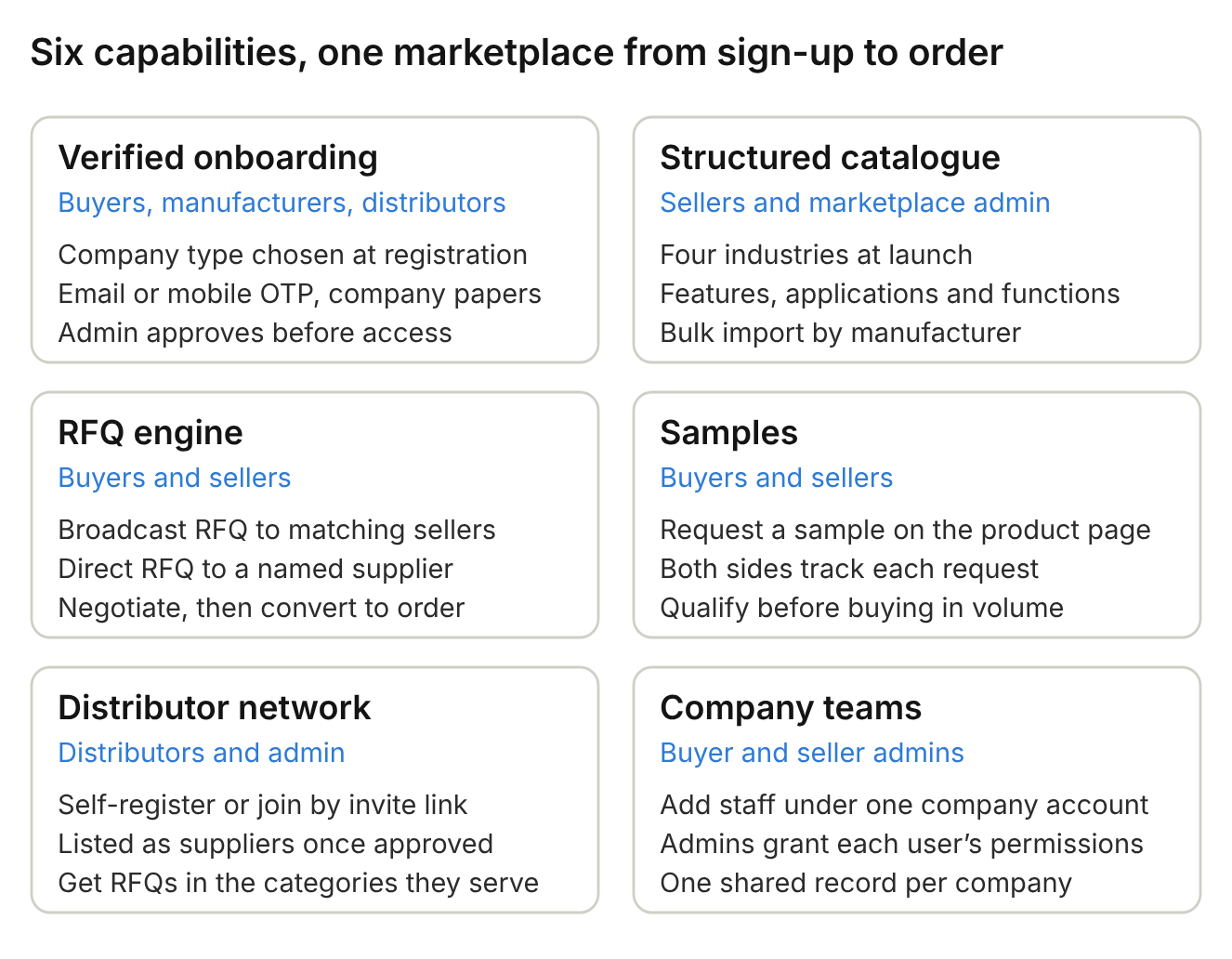
- Verified onboarding. Companies register as a buyer, manufacturer or distributor, verify by email or mobile OTP, and upload company documents. The marketplace team approves each company before it can trade.
- Structured catalogue. Products launch across four industries: Home Care, Personal Care, Coating & Construction, and Food & Beverage. Each product carries structured features, applications and functions, and sellers can load products in bulk from Excel templates.
- Distributor network. Distributors can self-register or join through an invite link from the marketplace team. Once approved, they are listed as suppliers and receive RFQs in the categories they serve.
- Company teams. Buyer and seller admins add their own staff under one company account and decide what each user can do.
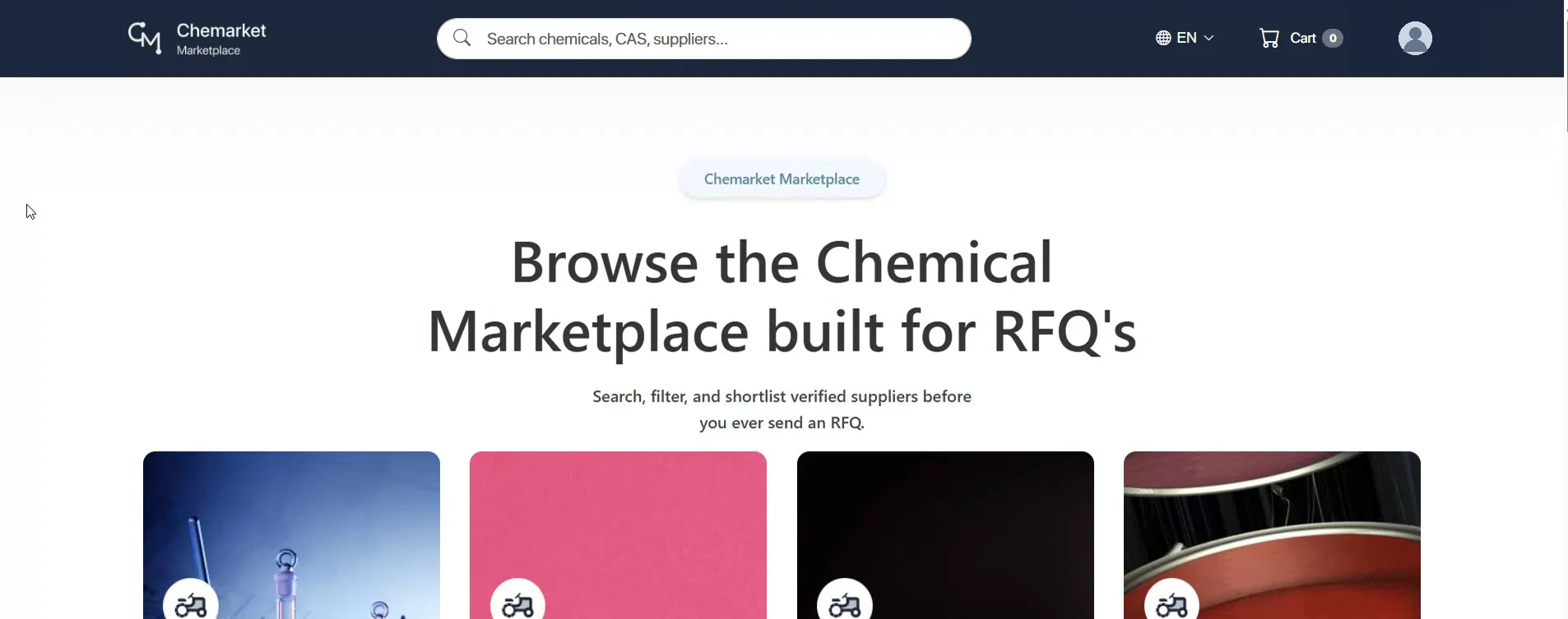
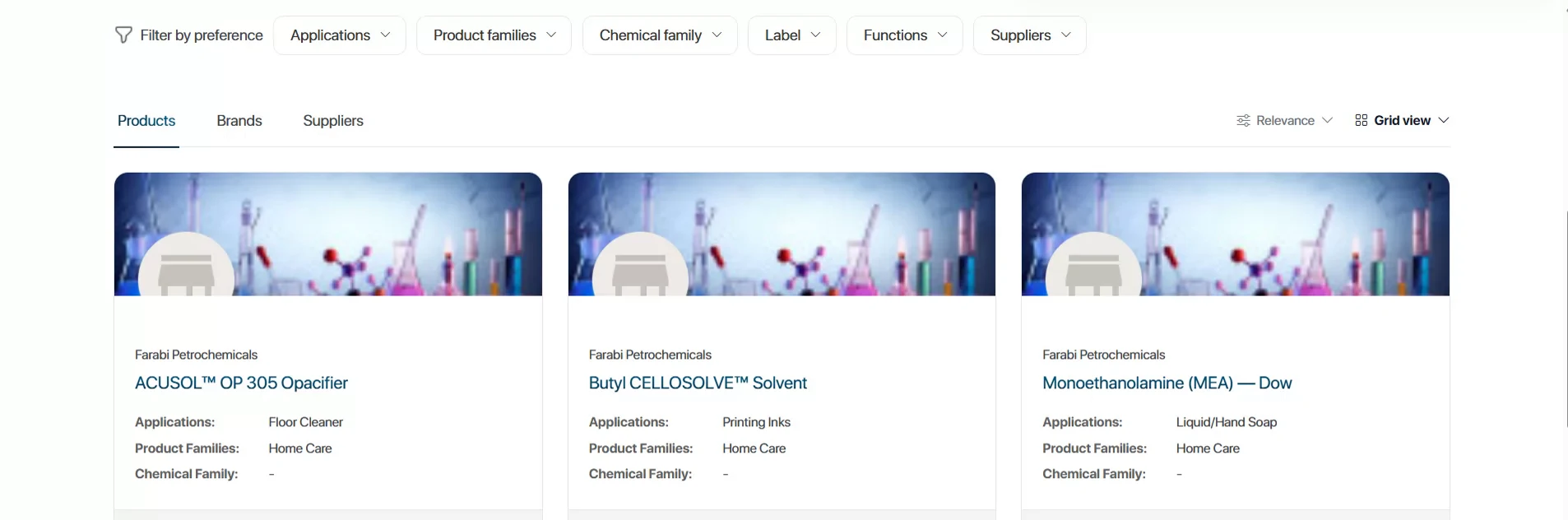
Buyers search by chemical name, CAS number or supplier, then narrow results by application, product family, chemical family, function and supplier. Every product shows its brand, applications and family up front, so a buyer can shortlist before sending a single RFQ.
B2B trade, the way chemical companies buy
The request for quotation (RFQ) is at the centre of CheMarket, because that is how chemicals are bought. We built two routes to market, so a buyer can either test the market or deal with a supplier they already know.
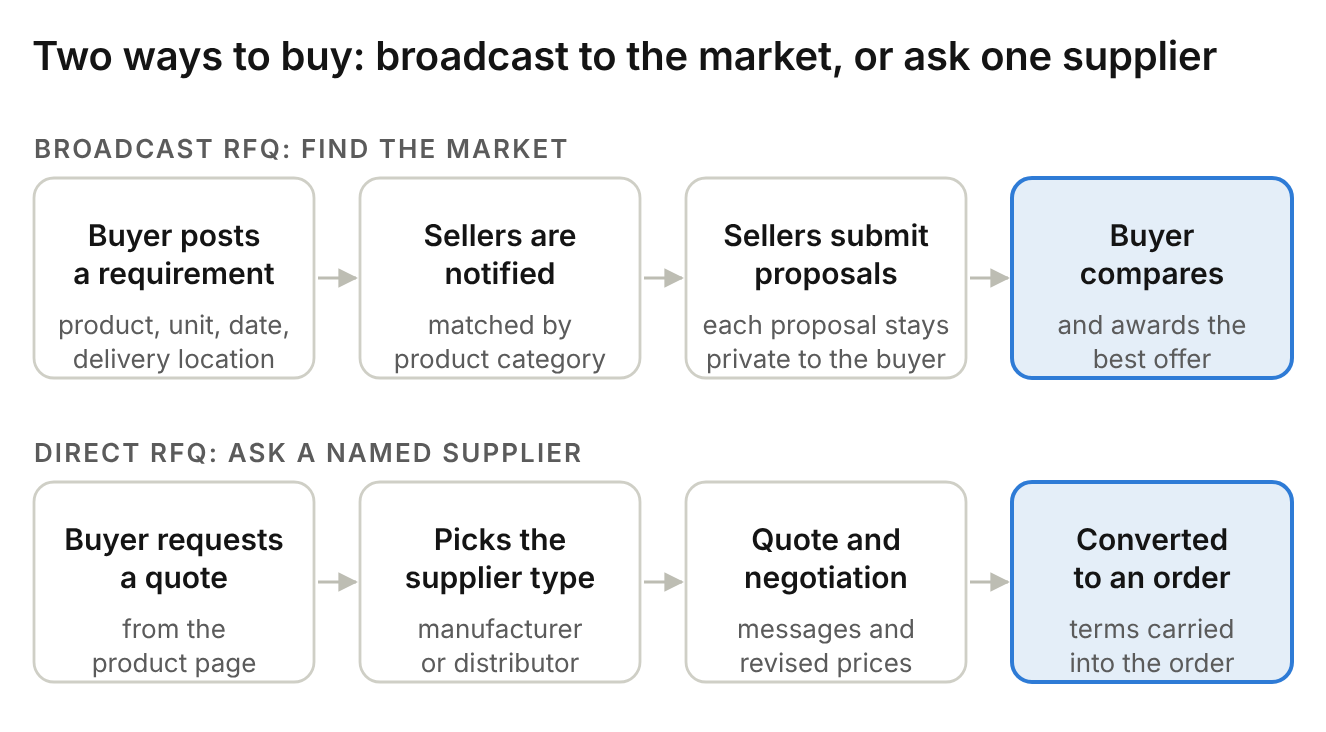
A broadcast RFQ reaches every manufacturer and distributor that serves the product's category, and each proposal stays private to the buyer, so suppliers compete on a level field. A direct RFQ goes to a named supplier from the product page, with quotes, messages and revised prices kept in one thread until the agreed quote converts to an order.
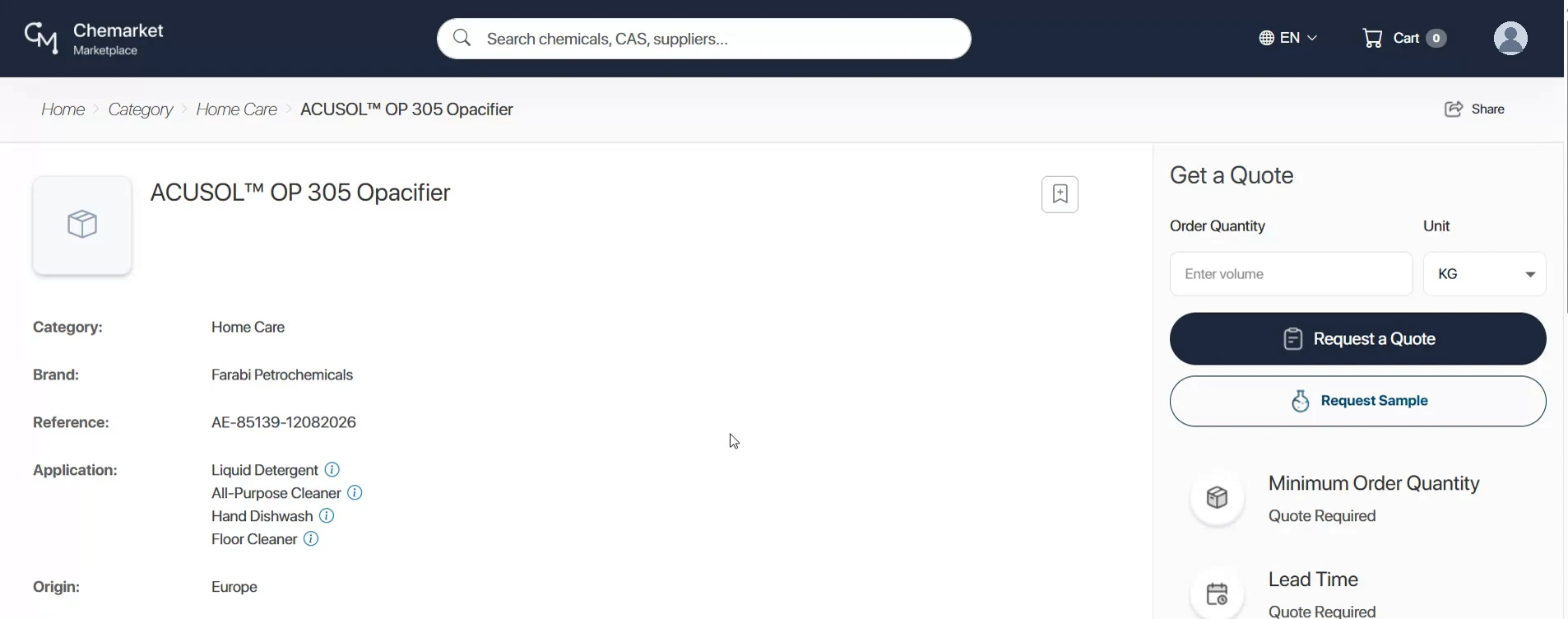
On each product page, the buyer enters a volume and unit and requests a quote. The request captures what B2B trade needs: how the product will be used, the Incoterm, the expected date and any attached specifications. Minimum order quantity and lead time are confirmed in the quote, not guessed from a price tag.
Before committing to volume, buyers can request a sample straight from the product page, and both buyer and seller track each request. Technical qualification moves out of inboxes and into the platform, next to the product and the quote.
One year from idea to go-live readiness
We delivered a full B2B marketplace in twelve months by building only what made CheMarket different and adopting proven platforms for everything else. We started in August 2025, and the platform was ready for go-live in August 2026.
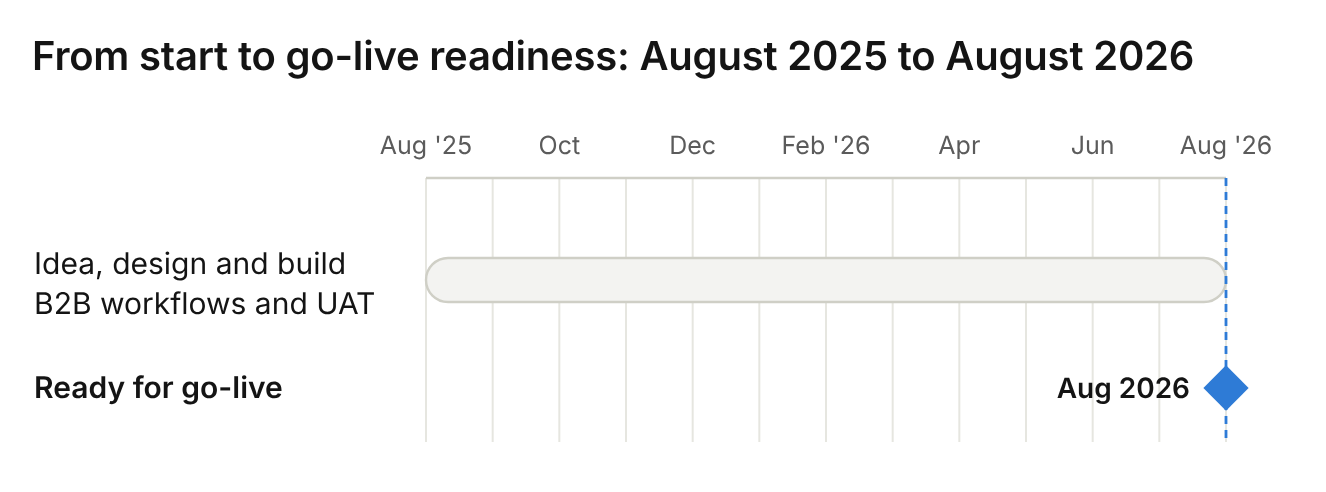
Our Startup Venture Stream moved CheMarket through four steps, each one building on the last:
- Idea. We mapped chemical sourcing with CheMarket's founders: who buys, who sells, and where time, price and trust leak away.
- Core marketplace. We launched verified onboarding and the structured catalogue first, because every later workflow depends on trusted companies and clean product data.
- B2B workflows. We added broadcast and direct RFQs, quote negotiation, samples, the distributor network and company teams.
- Go-live readiness. We ran structured user acceptance testing on every core journey and reviewed the Arabic experience label by label.
Three choices kept cost and time down:
- Proven commerce core. We built on PrestaShop 8, an open-source commerce platform, so catalogue, search, checkout and administration did not have to be written from scratch.
- Custom where it matters. We built CheMarket's B2B layer as separate modules on top of the core: RFQs, samples, approvals, distributor flows and company teams. That keeps the platform upgradable.
- Built to connect. We designed the marketplace around clean company, product and order records, so ERP and finance systems can plug in without rework.
Our technology stack at a glance:
| Layer | Technology |
|---|---|
| Commerce core | PrestaShop 8 with a multi-seller marketplace layer |
| B2B workflows | Custom modules for RFQs, samples, approvals, distributors and company teams |
| Verification | Email and mobile OTP, company documents, admin approval |
| Languages | English and Arabic, with full right-to-left layout |
Quality built in, and measured
In B2B trade, a broken RFQ or a wrong approval costs real money, so we treated quality as part of the build, not a final check. Every core journey went through structured user acceptance testing (UAT) with positive, negative and validation cases before we called the platform ready.
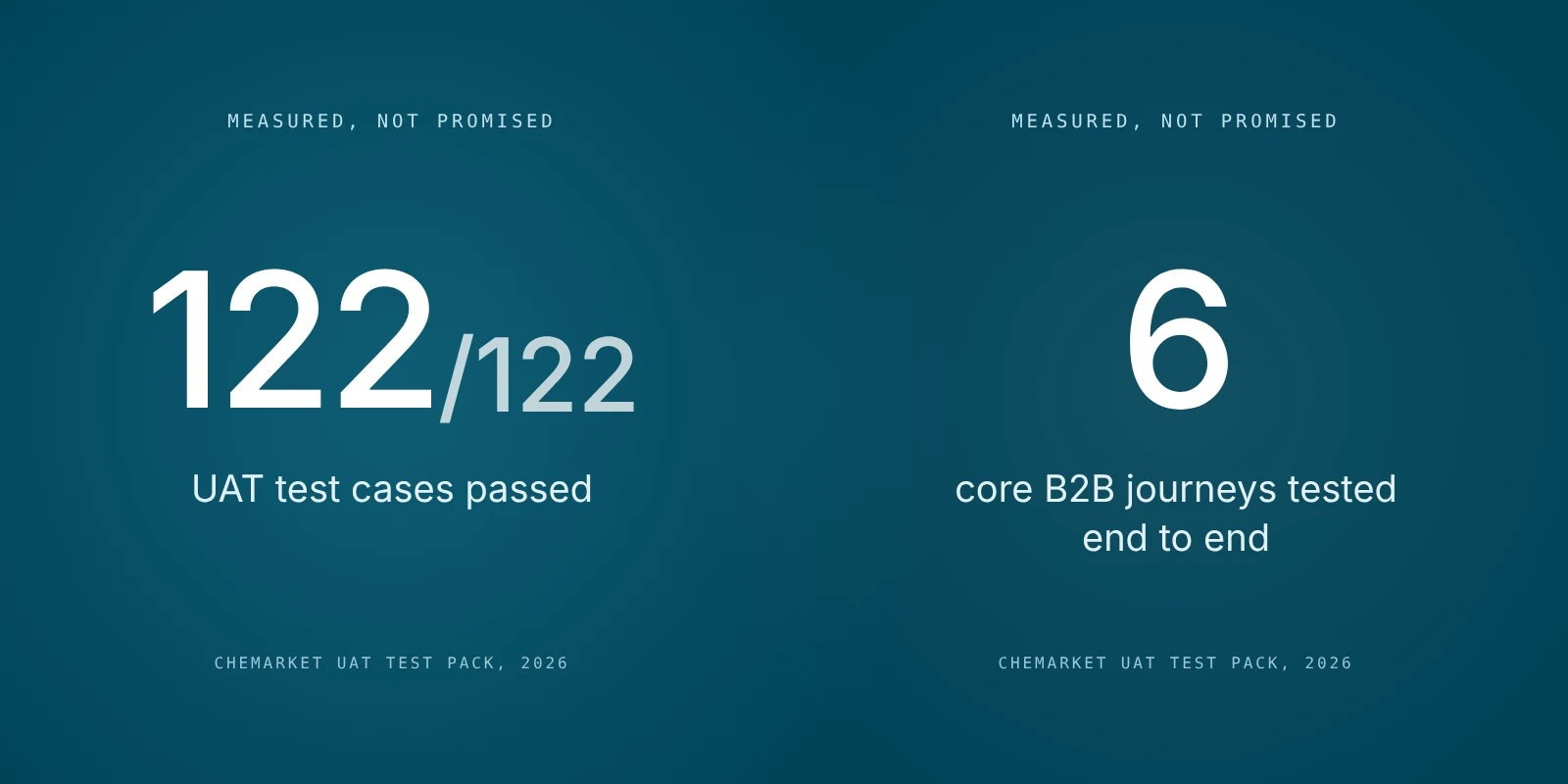
The six journeys covered were registration and login, broadcast RFQ, seller proposals, direct RFQ, sample requests and the distributor flow. Quality also meant:
- A real Arabic experience. We reviewed the storefront's Arabic text in a chemicals-trade context rather than translating word for word: of 209 core storefront labels, 67 were refined for Saudi business usage.
- A separate UAT environment. Every change is tested away from production before it reaches users.
- A record as you work. Approvals, RFQs, quotes and messages are stored with the transaction, so the audit trail exists without extra effort.
What's next: ERP, e-invoicing and AI on CheMarket's data
With the marketplace ready, the next phase connects it to the back office and puts its data to work. Every party already works in one platform, so each next step builds on records that exist today.
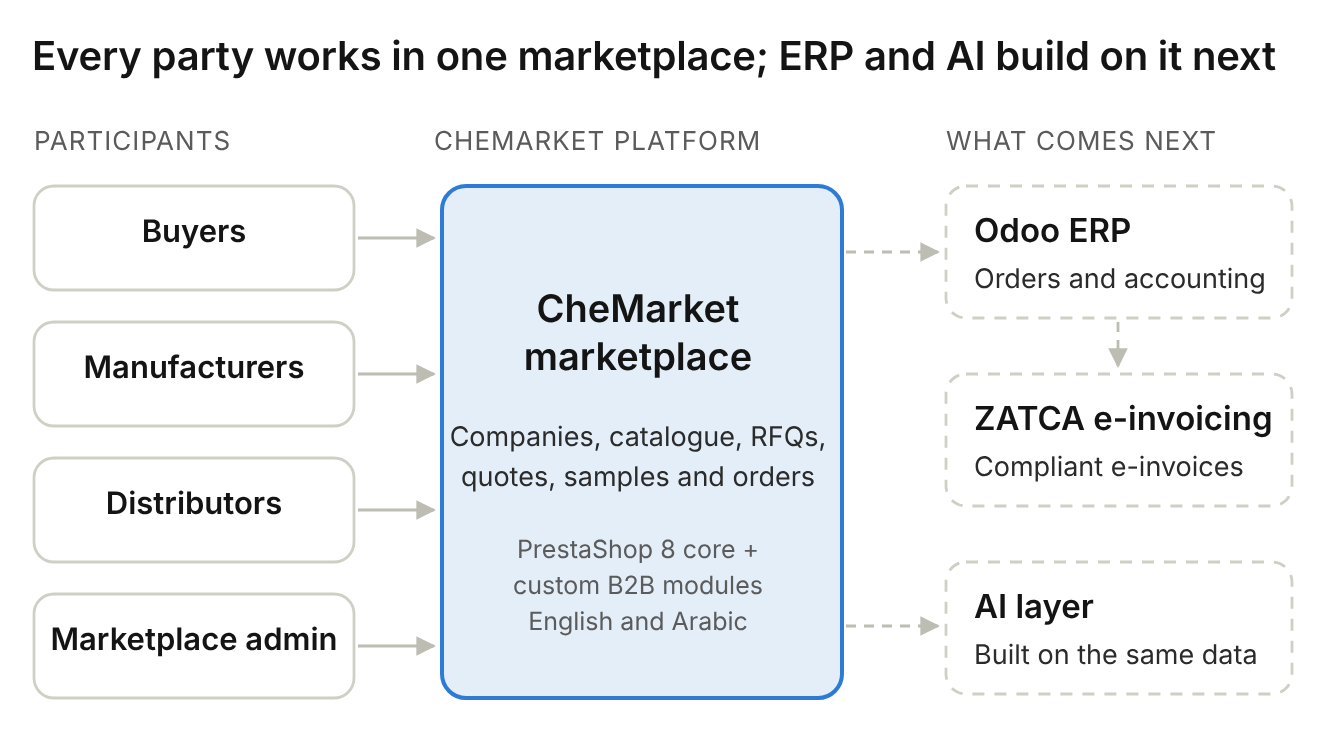
- Odoo ERP. Orders agreed on CheMarket will flow into Odoo for accounting, so no one re-keys a deal into finance.
- ZATCA e-invoicing. Invoices will be issued from those orders to meet ZATCA's e-invoicing (FATOORA) requirements, so the price and quantity invoiced match what was agreed.
On the AI side, every RFQ, quote, sample and order is structured data, which is what makes AI useful here. The areas we are exploring:
- Smarter matching. Route each RFQ to the sellers most likely to quote, based on category, past responses and fulfilment.
- Price benchmarking. Show buyers how a quote compares with recent quotes for the same product and grade.
- Product data from documents. Read technical and safety data sheets to fill product features automatically, in English and Arabic.
- Bilingual search. Let buyers search in Arabic or English, by trade name, chemical name or application.
From idea to a ready B2B marketplace
CheMarket shows what our Startup Venture Stream delivers: a full B2B marketplace, built in one year and tested before launch. We brought the product thinking, the B2B workflow design and the quality discipline, and we keep building with CheMarket as it goes to market, with ERP integration and AI next.
Need a technology partner for B2B commerce or ERP? Talk to us, and see CheMarket as it goes to market.